
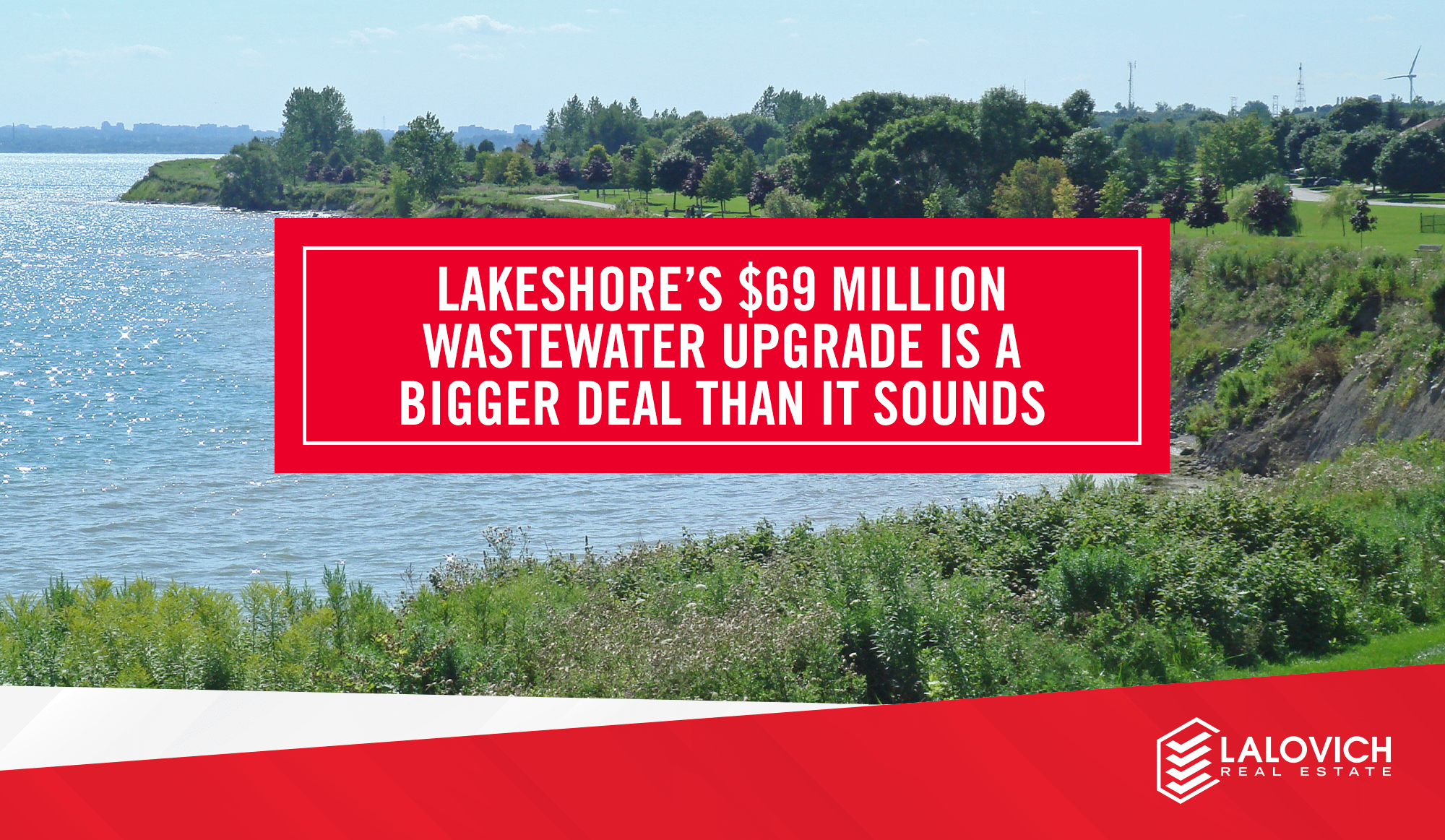
Lakeshore’s $69 Million Wastewater Upgrade Is a Bigger Deal Than It Sounds
Posted on May 27th 2026 by Lalovich
When people talk about growth in Lakeshore, the conversation usually turns to new homes, new businesses, traffic, development pressure, or how quickly some parts of the municipality are changing.
But behind all of that is something much less flashy: sewers, wastewater systems, and treatment capacity. It’s not exactly the kind of thing that grabs headlines, but it matters quite a bit.
Lakeshore recently approved more than $69 million in major wastewater upgrades, including the replacement of the aging Stoney Point sewage lagoons and the construction of a new sewage treatment plant planned for 2027. The project is expected to serve communities like Comber and Stoney Point-Pointe-aux-Roches. Council also approved more than $7 million for the Belle River sanitary sewer expansion, which is expected to begin in 2030.
That is a major investment. For residents, property owners, and anyone watching growth in Windsor-Essex, it deserves some attention.
Why This Matters For Lakeshore Residents
Wastewater infrastructure is one of those things most people only think about when there is a problem. But when it’s working properly, it quietly supports everything around us. It supports existing homes and supports new subdivisions. It supports businesses and protects local waterways. It also plays a major role in whether future development can actually happen.
You can approve all the housing you want on paper, but if the sewer and water systems cannot handle the growth, development will hit a wall.
Lakeshore is not just fixing old infrastructure. It is preparing for what the municipality may look like over the next 10, 20, and 30 years.
Replacing Aging Lagoons With A New Treatment Plant
The biggest piece of this project is the replacement of the Stoney Point sewage lagoons.
Sewage lagoons are older wastewater treatment systems that use large pond-like basins to help treat wastewater. They can work, but they also take up a lot of land, are more exposed to environmental pressures, and can become harder to rely on as communities grow and regulations become stricter.
Lakeshore’s plan is to build a new sewage treatment plant in 2027. This is a more modern solution. It should give the municipality better long-term control, more capacity, and a stronger foundation for future servicing needs in areas like Comber and Stoney Point-Pointe-aux-Roches.
This is not the type of project residents will necessarily see every day, but it will affect the way the area grows.
Belle River Is Part Of The Bigger Picture Too
Council also approved more than $7 million for the Belle River sanitary sewer expansion, expected to begin in 2030. That project may create more visible disruption once construction starts, depending on the final route of the sanitary trunk line.
However, this is the trade-off with growth. If a community wants to support more housing, more commercial activity, and more long-term development, the underground systems need to be able to handle it. It’s not glamorous, but it’s necessary.
The Growth Conversation Is Really An Infrastructure Conversation
This is where the story gets important for anyone following real estate or development in Lakeshore. A lot of people look at land and ask, “Can this be developed?” But one of the first questions should be, “Can it be serviced?”
If there is not enough wastewater capacity, development becomes difficult, expensive, delayed, or sometimes impossible. That applies to residential growth, commercial projects, employment lands, and future mixed-use development. Municipal infrastructure decisions often shape where growth goes before the average person ever sees a site plan or a building permit.
This $69 million wastewater upgrade is a signal that Lakeshore is preparing for future growth in a serious way.
What About The Cost?
The dollar figure is big. There’s no way around that. More than $69 million for the Stoney Point and Comber wastewater project, plus more than $7 million for Belle River, is a major commitment for a municipality.
Lakeshore has secured nearly $80 million in provincial and federal grant funding since 2025. That matters because without outside funding, the pressure on local water and wastewater rates could have been much heavier. Infrastructure is expensive. Someone always pays for it. The better question is how much of that cost lands directly on local residents and how much can be offset through senior government funding.
In this case, those grants appear to have helped reduce the projected impact on water and wastewater rates. That’s a big deal for households already dealing with higher costs across the board.
The Environmental Side Matters Too
Wastewater upgrades are not just about development, they’re about protecting the environment. As communities grow, there is more pressure on existing systems. Older infrastructure can struggle to meet current environmental standards, especially as regulations become stricter.
A more reliable wastewater system helps protect local water quality and reduces the risk of problems that can become much more expensive later. Spending money now can be painful, but deferring infrastructure can be even more expensive.
Our Take
This is one of those municipal decisions that won’t get the same attention as a new subdivision, a new restaurant, or a big commercial announcement, but it may matter more than all of them.
Infrastructure is the foundation. If Lakeshore wants to keep growing, it needs systems that can support that growth. Sewer and wastewater capacity are not optional. They are the backbone of responsible development.
This project tells us that Lakeshore is thinking beyond the next few years. It’s preparing for the next phase of growth, and that has real implications for residents, landowners, developers, investors, and businesses across the area.
It also shows how important grant funding is becoming for local municipalities. These projects are getting bigger, more technical, and more expensive. Without support from higher levels of government, the pressure on local ratepayers can become very real, very quickly.
So while $69 million in wastewater upgrades might not sound exciting at first, it is absolutely worth noting. In real estate and community growth, what happens underground often determines what gets built above it.
Share: Share on facebook Send it with e-mail Share on twitter Share on linkedin